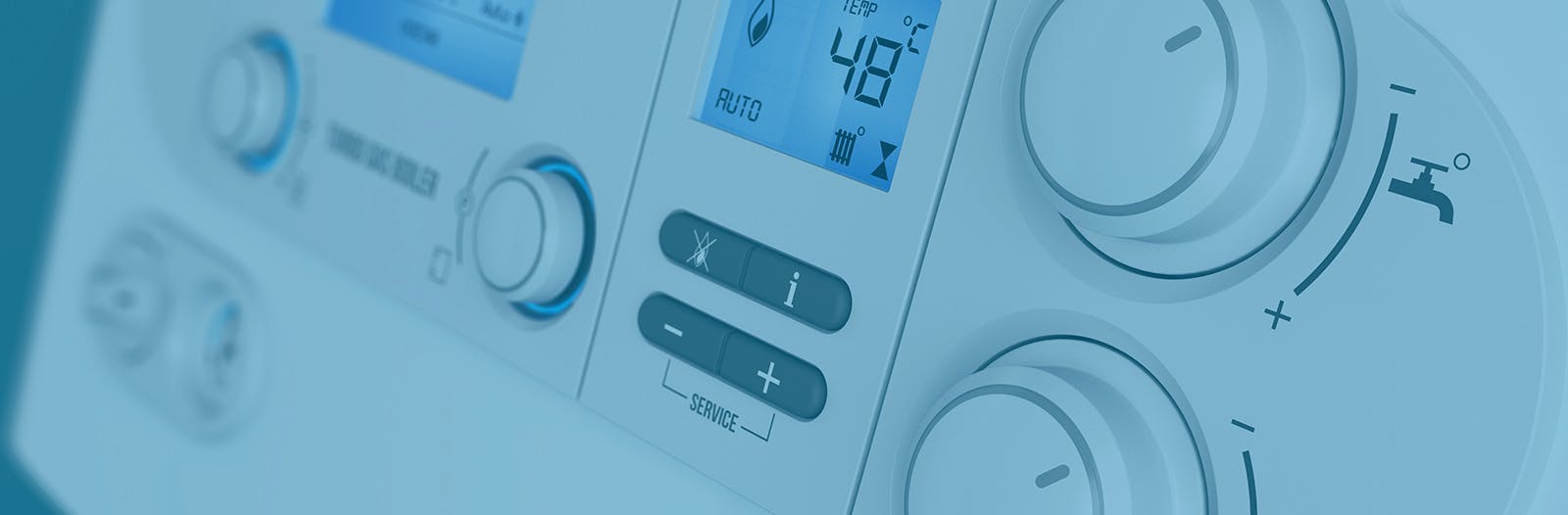
If your boiler keeps turning itself off, it is usually protecting itself. Modern boilers are built to shut down, or "lock out", when something isn't right, such as low water pressure, a frozen condensate pipe, overheating or a problem with the flame. Sometimes it isn't a fault at all, just the thermostat or timer doing its job.
This guide covers how to tell normal behaviour from a fault, the checks you can safely make yourself, and the causes that need a Gas Safe registered engineer. You can look at the controls, the pressure gauge and the pipe outside, but never remove the boiler casing or keep resetting it.
Is it a fault or normal behaviour?
A boiler doesn't run non-stop. Once your home reaches the temperature set on the room thermostat, the boiler stops firing, then starts again as the rooms cool. A modern condensing boiler also turns its flame up and down to match demand, which is called modulating, so it may go quiet for a while.
It's worth ruling out the controls first. The clocks went back at the end of October, so a programmer that doesn't change itself may now be switching the heating off an hour early. A wireless thermostat with flat batteries can also stop asking the boiler for heat.
It's more likely to be a fault if the boiler shows a fault code or a red light, switches off while the rooms are still cold, or turns on and off every few minutes.
Safe checks you can make at home
These checks are safe for any homeowner:
- Look at the display for a fault code or warning light, and write it down.
- Check the pressure gauge. On most systems it should read between 1 and 1.5 bar when the heating is cold.
- Make sure your other gas appliances work, such as the hob. If you have a prepayment meter, check it still has credit.
- Check the thermostat is set above the room temperature and its batteries aren't flat.
- In cold weather, look at the plastic condensate pipe where it leaves the house.
- Reset the boiler once, as the manual explains. If it locks out again, leave it and call an engineer.
If you smell gas or your carbon monoxide alarm sounds, turn the boiler off, open windows, leave the house and call the National Gas Emergency number on 0800 111 999.
Low pressure
Your heating is a sealed system full of water, and the boiler needs enough pressure to move that water around. If the pressure drops below about 1 bar, most boilers switch off to protect themselves. Pressure often falls after radiators have been bled, or because of a small leak.
You can top it up using the filling loop, the short braided hose or key under the boiler that lets in water from the mains. Our guide on how to repressurise a boiler safely takes you through it. If you find yourself topping it up more than once every few months, there is a leak or a faulty part that needs finding.
A frozen condensate pipe
Condensing boilers make water as they burn gas, and it drains away through the condensate pipe. If the section outside freezes on a cold night, the water backs up and the boiler shuts down, often with a gurgling sound and a fault code. It's one of the most common reasons a boiler cuts out in winter.
You can thaw it with warm (never boiling) water or a hot water bottle. Our guide to a frozen boiler condensate pipe explains how, and what stops it happening again.
When it turns on and off every few minutes
If the boiler fires up, runs for a few minutes, stops, then starts again over and over, it is short cycling. It wastes gas and wears parts out faster.
Common causes include:
- a boiler that's too powerful for the home, so it heats the water too quickly and stops
- a room thermostat near a radiator, a sunny window or a draught, so it gets a false reading
- most radiator valves turned right down, so there's little need for heat
- poor water flow from a failing pump or sludge in the pipes
You can check where the thermostat sits and open up the radiator valves. The rest needs an engineer.
Overheating, sludge and limescale
Every boiler has a safety device that shuts it down if the water inside gets too hot. This usually happens when water can't flow properly through the heat exchanger, the part that passes heat from the flame into the water.
Two things often cause it. Sludge, a black sediment of rust and dirt, builds up in older systems and slows the flow. Limescale is the other, and it matters here because West Sussex has some of the hardest water in England. Scale slowly coats the narrow waterways inside a boiler, especially a combi's hot water side. Both need a professional clean or repair, so don't keep resetting a boiler that's overheating.
Faults that need an engineer
Some causes are inside the boiler and need a Gas Safe registered engineer:
- a faulty flame sensor, which tells the boiler the flame is lit and shuts off the gas if it goes out
- a problem with the fan or the flue, the pipe that carries fumes outside
- a failing gas valve or ignition part
- a fault on the printed circuit board (PCB), the boiler's control electronics
Never remove the casing or try to adjust gas parts yourself. A mistake with a gas appliance can cause a leak or carbon monoxide, which you can't see or smell.
What we do when we visit
When we come out to a boiler that keeps cutting out, we look at the fault code and how the boiler has been behaving, then work through the likely causes. We pinpoint the fault and only fit the parts that are needed, and we keep a stock of common spares so we can sometimes fix it on the first visit. If a repair wouldn't be good value, or parts are no longer made for an older boiler, we'll tell you plainly and talk you through a replacement.
A boiler that keeps turning off is rarely something to put up with, especially as the weather gets colder. If the simple checks haven't sorted it, The Sussex Heating Care Company can find the cause and put it right. Book a visit through our boiler repair service and we'll help get your heating back to normal.