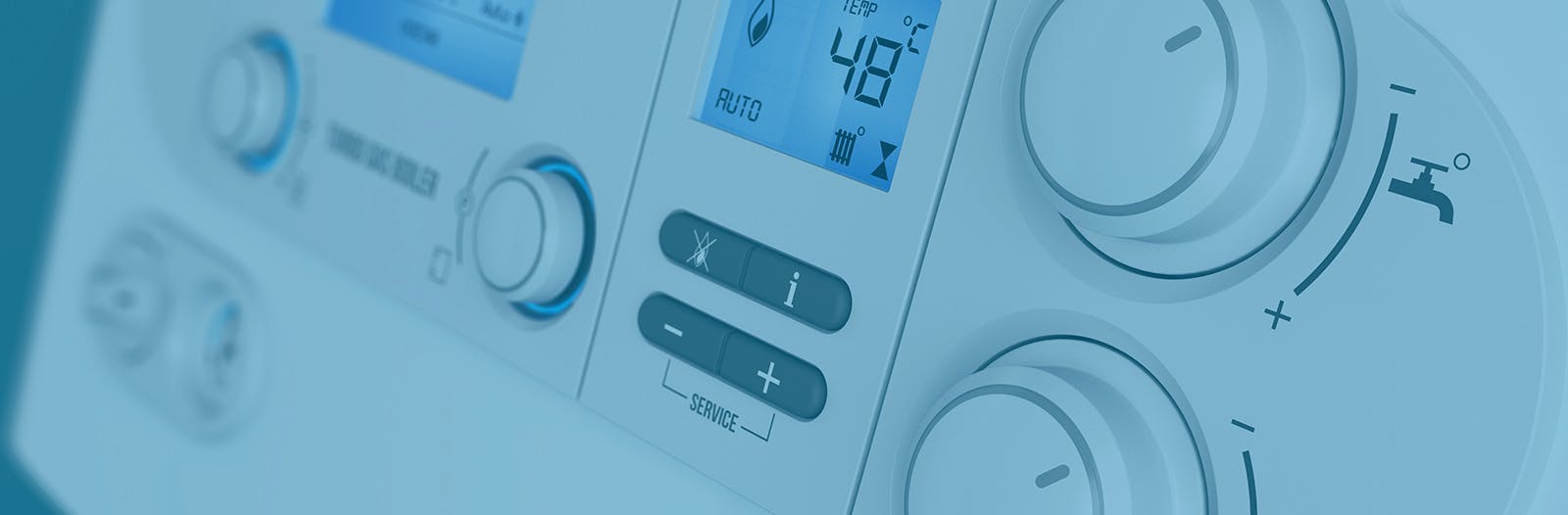
When your radiators warm up but the taps run cold, the boiler itself is usually working. The fault is normally in the part of the system that sends heat to your hot water instead of your radiators. On a combi boiler that is often a diverter valve or a flow sensor. On a boiler with a hot water cylinder it is often a zone valve, the cylinder thermostat or the programmer.
This post explains how to tell which type of system you have, the checks you can safely make yourself and the faults that need an engineer. You can look at settings, gauges and taps, but never remove the boiler casing or touch anything on the gas side. That is a job for a Gas Safe registered engineer.
First, check which type of boiler you have
A combi (combination) boiler heats water the moment you turn on a hot tap, so there is no hot water cylinder or tank. A system or regular boiler heats water in advance and stores it in a cylinder, usually in an airing cupboard. A regular boiler also has a cold water tank in the loft.
This matters because the parts that fail are different. If you are not sure which you have, look for a cylinder. If there is one, you have a system or regular boiler.
Safe checks you can make at home
Many no hot water call-outs turn out to be a setting. Work through these first:
- The hot water setting. Many combis have a separate hot water dial, or a "heating only" or summer and winter mode that is easy to knock. With a cylinder, check the programmer's hot water channel is on and the clock is right, especially after a power cut.
- The tap itself. A combi only fires for hot water when water flows fast enough. Open the tap fully. A tap that is barely open, or a blocked tap filter or shower head, may not be enough.
- The cold water. If the cold flow is weak at every tap, the problem may be your water supply rather than the boiler.
- The boiler display. Note any fault code and look it up in your manual. Our guide to boiler fault codes explains what you can safely check.
- The pressure gauge. It should usually read between 1 and 1.5 bar when the system is cold.
- The cylinder thermostat. This is a small dial strapped to the side of the cylinder. If it has been turned down, the water may never get hot. Stored hot water should be kept at 60°C, which also helps control legionella bacteria.
If you reset the boiler, do it once only. If the same fault comes back, leave it switched off and call an engineer. If your cylinder has an immersion heater (an electric element inside the tank), switching it on can give you hot water while you wait.
Common causes in a combi boiler
A stuck diverter valve
The diverter valve decides where the boiler's heat goes, either round the radiators or to the hot taps. If it sticks in the heating position, the radiators get hot and the taps stay cold. A common clue is radiators warming up when you run a hot tap in summer, with the heating switched off.
A faulty flow sensor
The flow sensor tells the boiler that a hot tap has been opened. If it fails, the boiler never gets the message, so it doesn't fire for hot water even though the heating works normally.
A scaled-up plate heat exchanger
The plate heat exchanger is a small unit inside a combi that passes heat from the boiler's own water into your tap water. Limescale can build up inside it. The usual signs are water that is only lukewarm, temperature that swings between hot and cold, or hot water that takes a long time to arrive.
Common causes with a hot water cylinder
A motorised zone valve that won't open
A zone valve is an electrically driven valve that opens to let hot water from the boiler flow through a coil inside your cylinder. If its motor fails or the valve sticks shut, the heating carries on as normal but the cylinder slowly goes cold.
The cylinder thermostat or programmer
If the cylinder thermostat or the programmer fails, the boiler is never asked to heat the cylinder. The heating keeps working because it has its own controls.
Unvented cylinder faults
An unvented cylinder is fed straight from the mains and stores water under pressure, so it has safety valves. If water is dripping from the tundish (a small open funnel in the pipework near the cylinder), or the hot water is erratic, don't touch the valves. Call an engineer who works on unvented cylinders.
Why hard water can make it worse
Much of the local water comes from the chalk of the South Downs. Portsmouth Water says this makes its water moderately hard, which can cause limescale to build up on hot water appliances. Inside a boiler or cylinder, that scale coats the plate heat exchanger and the cylinder coil, so less heat reaches your water.
An annual boiler service is a good time to spot early signs of scaling. A scale reducer fitted on the cold supply to a combi can also help protect it.
What not to do
- Don't remove the boiler casing or try to free a valve inside it.
- Don't touch the gas valve or any gas pipework.
- Don't keep resetting the boiler if the same fault keeps coming back.
- Don't adjust the safety valves on an unvented cylinder.
What we do when we visit
We start by finding out exactly which part has failed. We test the controls, the valves and the sensors, then only fit the parts that are needed. We carry a stock of the parts most likely to be needed, so we can sometimes fix the boiler on the first visit.
If your boiler is older, replacement parts may be hard to find, or a repair may not be worth the cost. If that happens, we'll explain your options plainly so you can decide what is right for your home.
If your heating works but your hot water doesn't, and the checks above haven't sorted it, The Sussex Heating Care Company can find the fault and put it right. Book a visit through our boiler repair service and we'll get your hot water running again.